Getting Started With the Common Lisp Hyperspec

Jean-Philippe Paradis over at HexstreamSoft has a nice page about getting started with the Common Lisp Hyperspec. If you’re already familiar with the Hyperspec, you’re probably with most of the material. If you’re not, it’s a nice introduction.

One thing that I found really helpful was detailed instructions for installing a local copy of the Hyperspec on your computer. If you often find yourself working off line, that can be a real lifesaver.

Paradis has a lot of Common Lisp material on his site so if you’re there for the Hyperspec introduction, take a look around at some of his other offerings.

Posted in Programming | Tagged , | Leave a comment

Ace-Link

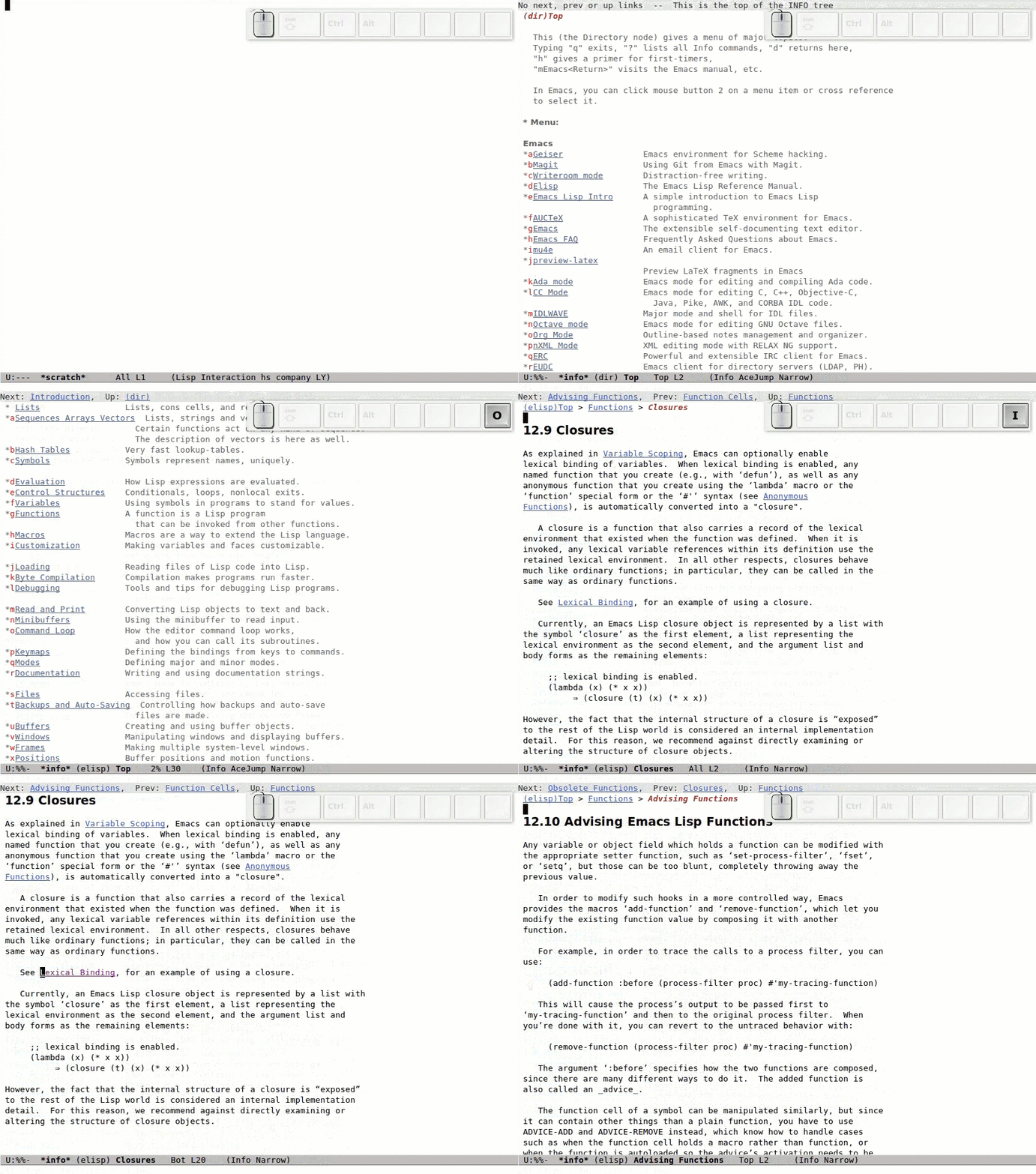
Oleh Krehel has a nifty new package that brings ace-jump-mode functionality to links in help and info buffers. The package, ace-link, makes following links easy by putting letters in front of each link. You follow the link by picking the appropriate letter.

It’s available through MELPA so installing it is easy. The only thing you need to do is initialize the binding (‘o’ by default) by adding

(ace-link-setup-default)

to your .emacs or init.el file. Alternatively, you could set the key map manually and use some other key.

I just loaded ace-link and while I’ve played around with it, I haven’t used it “for real” yet. So far, though, I like it a lot. Just as ace-jump-mode gives you an easy way to jump around in your buffer, ace-link makes it easy to follow links.

Posted in General | Tagged | Leave a comment

SBCL 1.1.17

SBCL 1.1.17 is out. As usual, it built and passed the tests without problems. This months release has a bunch of bug fixes and a couple of enhancements/optimizations. See the NEWS page for details.

And no, despite Rainer Joswig’s April 1st announcement, there is no support for Clojure.

Posted in Programming | Tagged , | Leave a comment

Narrowing the Fancy Way

Bruce Connor has an interesting new package up at GitHub. It’s the fancy-narrow package that, as he puts it, imitates narrow-to-region with more eye candy. At first I hated the idea. Being crotchety and grumpy, I’m inclined to treat “eye-candy” with disdain. After all, didn’t I rail against those who wanted Emacs to be prettier?

After a nice nap, though, I had second thoughts. What fancy-narrow does is identical to narrow-to-region except that instead of blanking the text outside of the narrowed region, it grays it out. The grayed out text is readonly and unreachable. The advantage of fancy-narrow is that the surrounding text is still there for context.

The disadvantage is that the surrounding text is still there. To me, the main reason for using one of the narrowing commands1 is that you see only the text you’re interested in and nothing else is there to distract you. Graying out the other text makes it less intrusive but it’s still there.

I still can’t decide if I like it enough to install but I can see how it might be helpful. What do the rest of you think? Is this something you’d find useful?

Footnotes:

1

As opposed to using it programmatically as a way of making the narrowed region appear as the whole buffer as far some Elisp code is concerned.

Posted in General | Tagged | 5 Comments

Graphviz-dot Mode

When I want to draw structural directed graphs and network diagrams my first choice is always dot from the graphviz suite. The syntax is reasonably simple and the documentation has lots of examples to serve as go-bys.

The other day, Grant Rettke, whose blog you should definitely follow, had a post on configuring cask. That’s something I’ve been meaning to investigate so I was happy to see his post. But more interesting to me was the example he gave on configuring cask for graphviz-dot-mode, a mode for editing dot files.

If you like syntax highlighting—and who doesn’t—and write dot files, this package seems like a useful addition to your Emacs resources. Once again, Emacs shows that it can adapt to whatever task is at hand. Having syntax highlighting and formatting for dot files is probably not life changing but it does reduce friction a bit in your work flow. And that’s always a win.

Posted in General | Tagged | Leave a comment

Generating Graphs from an Org Mode File

I came across this tweet from Sacha Chua

and decided to take a look. I’m glad I did. The page is a detailed list of Chua’s goals. If you’re a Chua fan like me, the existence of such a page is not a surprise but why should we care? Aside from what we might learn from the goals themselves, the generation of the page has a lot to teach us.

One of the features of the page is a graph that maps her goals and how they relate to each other. What’s nice is that the graph is generated programmatically from the text on the page. That would involve a lot of work but for the fact that the page was generated from an Org source file. There are some interesting things about that file.

First is that, in the manner of reproducible research, everything to generate the page is included in the Org file including the Elisp code that generates the graphviz dot file for the graph, and the invocation of graphviz that produces the png for the graph.

The second interesting thing is her use of org-map-entries to iterate through the goals. This eliminates at lot of the parsing that she would otherwise have to do.

Finally, Chua came up with a nice trick to wrap the labels in the graph. To see the advantage of this, she includes an old copy of the graph, without the wrapping, at the end of page. In order to keep the nodes reasonably small, she wraps the longer lines into two or more lines by inserting the label string into a buffer with the appropriate fill-column value and calling fill-region.

If you’re interested in using Babel and Org-mode in a reproducible research manner, studying Chua’s code will pay dividends.

Posted in Programming | Tagged , | Leave a comment

Emacs + Org Mode + Python

Back in July of last year I wrote about a great SciPy 2013 talk by John Kitchin on using Emacs, Org Mode, and Python for reproducible research. Today, I came across a reference to the talk, rewatched it, and enjoyed it all over again.

If you’re involved in research or produce technical documents and haven’t seen this video, I urge you to give it a watch. It’s less than 22 minutes so it doesn’t demand a huge time commitment. If you’ve already watched it, you may, like me, enjoy seeing it again. I’m mentioning this again mostly for the benefit of those who might have missed it the first time.

Posted in General | Tagged , | Leave a comment

CSS By Example

Via Jean-Philippe Paradis, I came across this CSS tutorial by Xah Lee. It’s nice because the page shows several examples of CSS effects. When you click on an effect, it takes you to a short tutorial that discusses the effect and shows the code. The tutorials also have links to other documentation.

If you’re an expert CSS user, this probably won’t be as useful to you as it is to someone like me who only rarely writes CSS. I always have to look things up and before seeing this page wouldn’t have had any idea how to produce the effects or even how to find out efficiently.

If you don’t already know this stuff and sometimes produce Web pages—even if it’s with something like Org Mode—you should take a look at the page. I’ve bookmarked it in my Docs bookmark so I can find it easily the next time I need it.

Posted in Programming | Tagged , | Leave a comment

Reformatting JSON

A long time ago, I wrote about a way to prettify JSON. It had the advantage that it didn’t require you to load a heavyweight package such as js2-mode when all you wanted was to reformat some JSON in a reasonable way. The downside was that it called a Python module, json.tool, to do the work. That’s OK unless you don’t have Python installed or don’t want to shell out to an external process.

Now Wataru Miyaguni has an Elisp solution that doesn’t require you to shell out to an external process. The json-reformat package reformats JSON into a standard format. If, like me, you don’t write in JSON enough to justify use of one of the heavyweight JSON packages but nevertheless occasionally want to reformat JSON into a publishable format, this could be just what you need.

Posted in General | Tagged | Leave a comment

Metadata and You

I know it’s preaching to the choir and even to me it seems like the gazillionith time I’ve written about it but we really must convince our friends and neighbors that metadata isn’t some harmless bit of information that’s on our phone bills anyway. After all, if metadata really were harmless and unrevealing, the NSA wouldn’t be so eager to collect it, would they? A recent article in The Guardian describes a study which shows that sensitive data about your life is easily discerned by examining metadata.

The study’s participants installed an application on their phones that recorded who they called and the duration of the call. Given that these were all volunteers, there’s some self-selection bias here but you’d think people with something to hide wouldn’t be signing up (although one participant was pretty clearly growing pot, so maybe they would). Another person was found to be almost certainly suffering from Multiple Sclerosis and a third to have just discovered that she was pregnant.

There were calls to Alcohol Anonymous, NARAL, gun shops, divorce lawyers, STD clinics, and strip clubs. Notice that with the possible exception of the pot grower, none of these activities are illegal or even particularly exceptional. They are, however, private matters that most people wouldn’t care to have made public and that’s the point. We hear over and over that “if you’re not doing anything wrong you have nothing to fear.” This study shows just how wrong that is.

The Guardian article is useful to point at when you’re trying to educate your less security-savvy friends about the dangers of metadata.

Posted in General | Tagged | Leave a comment