
Exploratory Programming In Emacs

This is the final post of my series on storing data as Lisp programs (see here, here, here, here, and here). I hope that those of you have read the whole series have a new or renewed appreciation for the concept of data as code that is one half of the data/code duality that Lisp provides. Today, I want discuss, just a bit, how I leveraged the power of Emacs to develop and debug the sample code in the series.

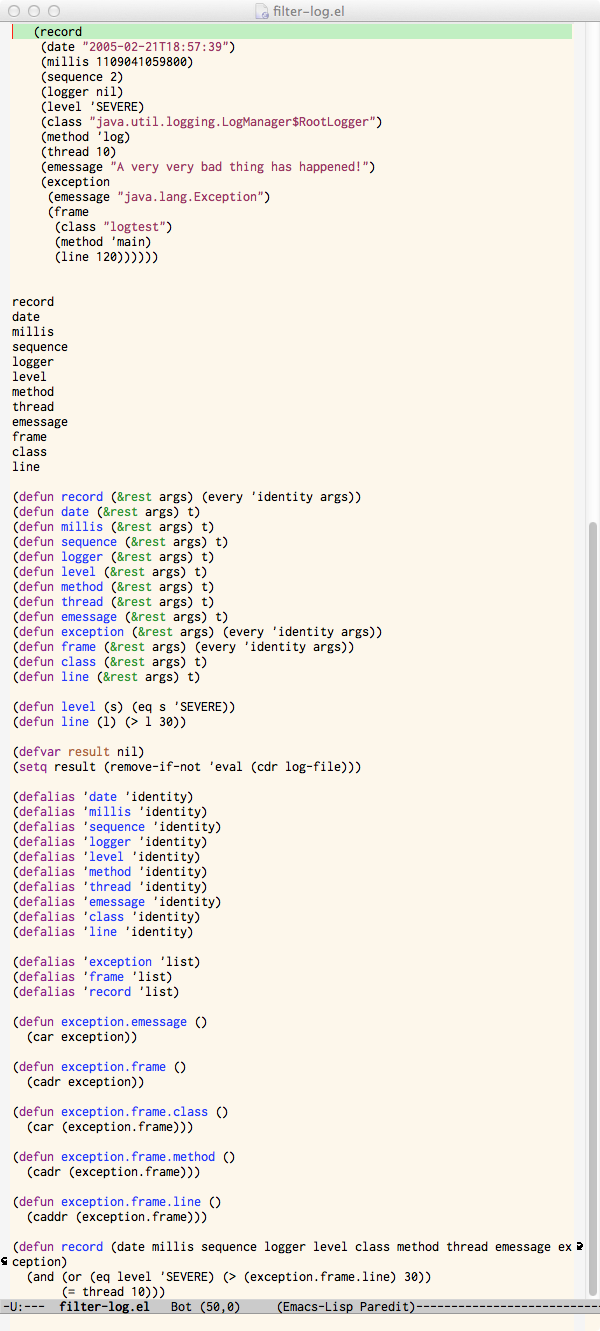
I’ve written before about how you can think of Emacs As A Lisp Machine: that is, the power of Lisp is always available to you. As an example of this, consider the “program” file that I used to develop code for the series. Here’s a screen shot of almost the entire buffer. Cut off at the top are 3 more records and an enclosing (log ...) sexpr that is assigned to log-file.
http://irreal.org/blog/wp-content/uploads/2011/12/wpid-filter-log.png

The thing to notice is that there are no real programs there, just a bunch of record and function definitions, a list of the tag names for the record structure and a few other miscellaneous pieces of code.

Walking through the process for the third problem of the previous post will make the process clear. I began by copying the list of tag names to the bottom of the file, narrowing to the list, and then running a keyboard macro on the narrowed buffer that changed each name into a call to defalias that defined the name as an alias for identity. Then I cut exception, frame, and record out of the list and changed the 'identity to 'list. All that’s just basic editing but with Emacs it involved almost no work: probably about 50 keystrokes total.

The next thing I did was to highlight the new function definitions and run eval-region. After that the new functions were defined and I could go to the end of one of the records and type 【Ctrl+x Ctrl+e】 to execute the record. That’s where the block showing the arguments to record came from.

Finally, I wrote the final 6 functions in the file and ran eval-region on them. That completed the solution to the third problem. I tested the solution first on each of the 4 records by running 【Ctrl+x Ctrl+e】 on each of them and then an actual filtering run by typing 【Ctrl+x Ctrl+e】 at the end of

(setq result (remove-if-not 'eval (cdr log-file)))

That resulted in the two records that passed the criteria being put in result.

The whole process is much more trouble to write down then it was to actually do. Emacs’ superb editing powers allowed me to write the support functions with an absolute minimum of effort and then to test and refine them interactively. Notice that there wasn’t even a REPL involved except for the implicit REPL that Emacs is always running as you type things into a buffer. The ability to select some code and execute it is tremendously powerful and liberating. And fast. During this development, I never left the filter-log.el buffer. There was no need to go to a separate REPL buffer, or to run a compile, or anything else.

I don’t program like this all the time, of course. Sometimes you just write a program or part of a program and then test it but when you’re feeling your way along—when you’re doing exploratory programming—it’s very nice to be able to write and try a snippet of code as small as a single statement. After a while, you begin to understand the problem better and you can drop back to the normal process of writing larger segments of code. At least until you need to do a little exploring again. Emacs supports both styles seamlessly and it’s easy to switch back and forth as needed. The power of Emacs can be astounding, even to those of us who are used to it.
Posted in Programming | Tagged , | 1 Comment

Filtering Lisp-Based Log Files With Emacs Wrap-Up

Yesterday’s post discussed some rudimentary methods of having log files stored as Lisp filter themselves. Today I planned to finish that discussion and remark on how Emacs provides a powerful environment for exploratory programming. The discussion of the 3 challenge questions from yesterday turned out to be longer than I anticipated, so I’ll discuss them today and make my final comments about Emacs and exploratory programming in a subsequent post.

The first question wants us to combine queries with or rather than and. In particular, how would you filter on

level equals SEVERE or line > 30

One way of doing this is to make the definitions

(defun level (s)
  (not (eq s 'SEVERE)))

(defun line (l)
  (<= line 30))

and then use remove-if instead of remove-if-not to filter the records.

The second question asks how you would filter on the method field that is part of the frame sexpr. The easiest way of doing that is to change the definition of frame to return the truth value of the condition. For example, if you wanted to filter on method being ‘main, you could define frame as

(defun frame (class method line)
  (eq method 'main))

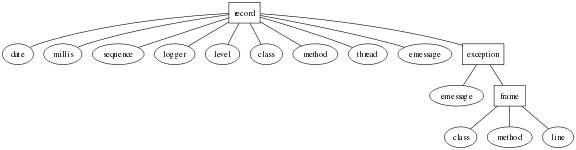
The third question shows that we’ve just been fooling around so far and that what we really need is access to all the fields. Our record structure looks like

http://irreal.org/blog/wp-content/uploads/2011/12/wpid-log.png

and the record function can’t see the emessage1, class, method, and line fields that are underneath the exception node. To get a general solution we need to arrange for record to have access to all the fields.

We start by having the leaf nodes just return their value. Thus, we define

(defalias 'date 'identity)

and similarly for millis, sequence, logger, level, class, thread, emessage, method, and line.

Next, we define the internal nodes exception and frame to return a list of their leaf values:

(defalias 'exception 'list)

and similarly for frame.

With these definitions, record has access to all the fields. To see what record‘s arguments look like, define record as list and execute one of the records. We get

("2005-02-21T18:57:39" 1109041059800 2 nil SEVERE
"java.util.logging.LogManager$RootLogger" log 10 "A very very bad
thing has happened!" ("java.lang.Exception" ("logtest" main 120)))

To get access to the leaves under exception, we need some accessor functions.

(defun exception.emessage ()
  (car exception))

(defun exception.frame ()
  (cadr exception))

(defun exception.frame.class ()
  (car (exception.frame)))

(defun exception.frame.method ()
  (cadr (exception.frame)))

(defun exception.frame.line ()
  (caddr (exception.frame)))

With these definitions we can filter on conditions by writing the appropriate record function. To filter on

(level equals SEVERE or line > 30) and thread equals 10

as the third question asked, we would define record as

(defun record (date millis sequence logger level class method thread emessage exception)
  (and (or (eq level 'SEVERE) (> (exception.frame.line) 30))
       (= thread 10)))

and then evaluate

(remove-if-not 'eval (cdr log-file))

as before.

Note that given some record structure, everything but the record function is fixed so that filtering on different criteria means that only the record function needs to be changed.

UPDATE: would → wouldn’t

Footnotes:

1 I changed the message field of the record to emessage so that I wouldn’t have to redefine Emacs’ message function.

Posted in Programming | Tagged , , | Leave a comment

Filtering Log Files Stored As Lisp With Emacs

Yesterday, I wrote about transforming log files stored as Lisp. Today, I want to continue that theme by considering how we can have the log file filter itself so that we can pick out records meeting certain criteria. I wasn’t going to bother with this but it’s so easy once you have the infrastructure set up, I thought it might be fun to explore it a bit. Yesterday, I worked in Common Lisp, today, just for variety, I’ll work in Emacs Lisp.

For the benefit of those just joining the discussion, here is a typical record (from Steve Yegge’s The Emacs Problem).

(record
  (date "2005-02-21T18:57:39")
  (millis 1109041059800)
  (sequence 1)
  (logger nil)
  (level 'SEVERE)
  (class "java.util.logging.LogManager$RootLogger")
  (method 'log)
  (thread 10)
  (message "A very very bad thing has happened!")
  (exception
    (message "java.lang.Exception")
    (frame
      (class "logtest")
      (method 'main)
      (line 30))))

To help me in developing code for this post, I duplicated this record 4 times, changing some of the fields, wrapped it in a (log ...) sexpr, and put it in the variable log-file. As we did yesterday, we start by making each of the tags executable. To start, we define record, exception, and frame as functions that perform an and operation on their arguments. The record function is defined as

(defun record (&rest args) (every 'identity args))

and the other two are the same except for their names. See Applying and And or In Emacs for why something like (apply 'and args) won’t work. The other tags are defined as functions that just return t. For example, date is

(defun date (&rest args) t)

Now let’s suppose we only want to see records that have a level of SEVERE. We redefine level as

(defun level (s) (eq s 'SEVERE))

and filter out the other records by running

(remove-if-not 'eval (cdr log-file))

The remove-if-not function filters out any records that fail the “predicate” eval. Because eval evaluates the record sexpr it returns a t or nil value for each record. In this case, records without a level of SEVERE will have level return nil and therefore record will also return nil and therefore be filtered out.

We can build up more complicated conditions if needed. For example, if we want to see only records with a level of SEVERE and a line greater than 30, in addition to redefining level, we would also redefine line as

(defun line (l) (> l 30))

and run the remove-if-not function on log-file.

If you’re interested in this sort of thing, here are some problems to think about

  1. How would you filter on
    level equals SEVERE or line > 30
    
  2. Notice that method appears twice in the record. How would you filter on the one that’s in the frame sexpr?
  3. How would you handle general queries such as
    (level equals SEVERE or line > 30) and thread equals 10
    

I’ll give my answers to those questions in the next installment.

It might seem like this is a lot of work to run a query given that there are general tools available for doing so but it doesn’t take nearly as much effort as you might think. First of all, you would have a lot of these functions already defined so that you can just paste them into your buffer, redefine the filtering conditions, and run the filter. In the next installment, I’ll talk about how writing these functions, even if you don’t already have them, is really easy when you leverage the power of Emacs. I’ll also discuss how I used Emacs to develop and test the code interactively as I went along.

Posted in Programming | Tagged , , | Leave a comment

More Fun With Log Files Stored As Lisp

A couple of days ago, I wrote about Converting S-Expressions To XML in Emacs. That post was occasioned by my recent rereading of Steve Yegge’s The Emacs Problem in which he talks about, among other things, the utility of storing data as a Lisp program. His thesis was that doing so allows you to easily perform all sorts of useful manipulations on your data.

Certainly, as my post on transforming sexprs to XML shows, it’s trivial to convert a log file stored as a Lisp program to XML. But that post didn’t really leverage the fact that the log record from Yegge’s example is (or can be made) executable.

If you look at it again closely, you’ll notice that it’s just a complicated sexpr and therefore executable as long as the “tags” in the function slots are defined as functions.

(record
  (date "2005-02-21T18:57:39")
  (millis 1109041059800)
  (sequence 1)
  (logger nil)
  (level 'SEVERE)
  (class "java.util.logging.LogManager$RootLogger")
  (method 'log)
  (thread 10)
  (message "A very very bad thing has happened!")
  (exception
    (message "java.lang.Exception")
    (frame
      (class "logtest")
      (method 'main)
      (line 30))))

To show how we can make the record transform itself, let’s start by defining the tags to just reproduce the sexpr that they head. The idea is simple. We could, for example, define record as

(defun record (&rest args)
  (cons 'record args))

With this definition, an expression such as

(record "abc" 123)

would evaluate to itself. In order to evaluate the full record from Yegge, we need to define functions for each of the function tags. To make that a bit easier we define a helper macro, prself.

(defmacro prself (f)
  `(defun ,f (&rest args)
     (self-print ',f args)))

so that

(prself record)

get transformed to

(defun record (&rest args)
  (self-print 'record args))

Unfortunately, self-print is a bit more complicated than our initial example because we have to quote symbols. That is, we want the sexpr

(level 'SEVERE)

to return an sexpr with SEVERE quoted instead of

(level SEVERE)

To do that, we need to quote all the symbols except nil and t.

(defun self-print (f args)
  (cons f
        (mapcar (lambda (a)
                  (if (and (symbolp a)
                           (not (eq a nil))
                           (not (eq a t)))
                      `(quote ,a)
                      a))
                args)))

Next we turn record, date, millis, …, line into functions with (prself record), (prself date), (prself millis), …, (prself line). At this point, the record is executable, and if we execute it directly we get

(RECORD (DATE "2005-02-21T18:57:39") (MILLIS 1109041059800)
(SEQUENCE 1) (LOGGER NIL) (LEVEL 'SEVERE) (CLASS
"java.util.logging.LogManager$RootLogger") (METHOD 'LOG) (THREAD 10)
(MESSAGE "A very very bad thing has happened!") (EXCEPTION (MESSAGE
"java.lang.Exception") (FRAME (CLASS "logtest") (METHOD 'MAIN) (LINE
30))))

That’s nice, but not very interesting. But suppose we want to transform the milliseconds field (millis) into seconds. We can do that by redefining millis as

(defun millis (m)
  `(seconds ,(/ m 1000.0)));

and if we execute record again, we get

(RECORD (DATE "2005-02-21T18:57:39") (SECONDS 1.109041E+9) (SEQUENCE 1)
(LOGGER NIL) (LEVEL 'SEVERE) (CLASS
"java.util.logging.LogManager$RootLogger") (METHOD 'LOG) (THREAD 10)
(MESSAGE "A very very bad thing has happened!") (EXCEPTION (MESSAGE
"java.lang.Exception") (FRAME (CLASS "logtest") (METHOD 'MAIN) (LINE
30))))

Again, that’s a trivial transformation, but it shows how easy it is to transform fields. Also notice that if we had a whole log of the form

(log
 (record
  (date...)...)
 (record
  (date...)...)
 ...
 (record
  (date...)...))

and ran prself on log, then we could transform the whole log at once without worrying about writing any looping code or anything else. Just execute the (log ...) sexpr and you’re done.

This is a long post but it shows the power of having your data be executable. Incidentally, I wrote this code using Common Lisp but the same functions would work just fine in Emacs Lisp.

Posted in Programming | Tagged , , | 1 Comment

This Is Just Too Weird

But if you want a visualization of quick sort, they’ve got you covered.

Posted in Programming | Leave a comment

Org Version 7.8.02 Is OUT

There’s a new version of Org mode available. You can download it from here. The download page also has instructions for cloning the Git repository so that you can stay as up-to-date as you like.

The main changes appear to be with Babel processing. Some of these are incompatible so if you’re a Babel user be sure to take a look. The changes page has an Elisp function to automate updating your old Babel buffers to the new syntax.

Concurrent with the new release, the Org team has also updated the site with a completely new look.

Posted in General | Tagged , | Leave a comment

Converting S-Expressions To XML In Emacs

My last two posts mentioned the ease with which s-expressions can be converted to XML and vice versa. Out of curiosity, I decided to write an sexpr to XML function in Elisp.

The implementation consists of two functions. The first, sexpr->xml, does the actual conversion, while the second, convert-to-xml, takes care of Emacs bookkeeping details and acts as a driver. For convenience, convert-to-xml takes an sexpr as its input but it would be easy to have it operate on a region or even a whole buffer.

We’ll use the example sexpr from Yegge’s The Emacs Problem post. Note that, again for simplicity, I am dealing with only a single record but everything would work exactly the same if there were multiple records wrapped in a '(log …) sexpr.

'(record
  (date "2005-02-21T18:57:39")
  (millis 1109041059800)
  (sequence 1)
  (logger nil)
  (level 'SEVERE)
  (class "java.util.logging.LogManager$RootLogger")
  (method 'log)
  (thread 10)
  (message "A very very bad thing has happened!")
  (exception
    (message "java.lang.Exception")
    (frame
      (class "logtest")
      (method 'main)
      (line 30))))

The converter is very simple.

1:  (defun sexpr->xml (sexpr)
2:    (let ((tag (car sexpr)))
3:      (princ (format "<%s>" tag))
4:      (dolist (o (cdr sexpr))
5:        (if (atom o)
6:            (princ (format "%s " o))
7:          (sexpr->xml o)))
8:      (princ (format "</%s>" tag))))

It’s passed an sexpr whose first symbol is the XML tag. That gets saved away in the let on line 2 and printed as the opening tag on line 3. The dolist loop in lines 4–7 looks at each of the other objects in the sexpr. If an object is not another sexpr, it is printed with a trailing space. If it is another sexpr, sexpr->xml is called recursively on line 7 to process it. When all the objects in the sexpr have been processed, the end tag is printed on line 8.

The output of sexpr->xml is a single line of XML with no formatting at all. Also, any nils will appear explicitly in the XML instead of the tag pair being empty and all the quoted symbols will be wrapped in <quote></quote> tags because the lisp reader turns 'symbol into (quote symbol).

Now let’s look at the driver function:

1:  (defun convert-to-xml (sexpr)
2:    (with-output-to-temp-buffer "*XML*"
3:      (sexpr->xml sexpr)
4:      (set-buffer "*XML*")
5:      (xml-mode)
6:      (replace-regexp "\\bnil\\b\\|<quote>\\|</quote>" "" nil (point-min) (point-max))
7:      (sgml-pretty-print (point-min) (point-max))))

Lines 2 and 3 call sexpr->xml and arrange for its output to go into a buffer named *XML*. When sexpr->xml returns, the *XML* buffer is selected and set to xml-mode (really nxml-mode). The replace-regexp on line 6 deletes any occurrences of nil and gets rid of <quote> and </quote> tags. Finally, sgml-pretty-print is called to format the XML nicely.

That’s a lot of work for not very much code. We could, of course, take care of the formatting and fixing up the nil and <quote> problems right in sexpr->xml but I wanted to show how simple the conversion can be without a lot of busy details. Besides, we have the power of Emacs so it would foolish not to use it.

The final result of running convert-to-xml on our sample sexpr is

<record>
  <date>2005-02-21T18:57:39
  </date>
  <millis>1109041059800
  </millis>
  <sequence>1
  </sequence>
  <logger>
  </logger>
  <level>SEVERE
  </level>
  <class>java.util.logging.LogManager$RootLogger
  </class>
  <method>log
  </method>
  <thread>10
  </thread>
  <message>A very very bad thing has happened!
  </message>
  <exception>
    <message>java.lang.Exception
    </message>
    <frame>
      <class>logtest
      </class>
      <method>main
      </method>
      <line>30
      </line>
    </frame>
  </exception>
</record>

Any Elisp coders out there might want to consider what a translator in the other direction (XML to s-expressions) would look like. Not having s-expressions to leverage makes the processing a little more difficult but not by much.

Posted in Programming | Tagged , | 2 Comments

Ruby vs. Lisp

Yesterday, I wrote about Steve Yegge’s The Emacs Problem post in which he examined a claim by a colleague that, among other things, Emacs should be rewritten to use Ruby as the interpreter. Today, serendipitously, I came across Learning Ruby, and Ruby vs. Lisp by Hans Hübner on his Netzhansa blog. Hübner is a Lisper who works in an environment where there is a lot of Ruby development going on and he decided to learn a bit about it. After reading The Ruby Programming language by David Flanagan and Yukihiro Matsumoto and doing a bit of programming, he could see the appeal or Ruby but felt that it didn’t offer him anything that Common Lisp didn’t have and that Ruby had some problems:

  • Ruby strives for succinctness but often at the cost of complex syntax and special case rules to resolve ambiguities.
  • Ruby’s functional programming aspects appear to have been bolted onto its original object oriented model after the fact. This makes using Ruby in a way that is not pure object oriented messy and hard to understand.
  • Ruby runs about 10 times slower than the same program in CL.

Yegge likes Ruby too but he believes it falls into the category of “scripting languages” by which he means “a bunch of miserable hacks: Perl, Python, Ruby, Groovy, Tcl, Rexx… you name it. They all start life with no formal grammar or parser, no formal bytecode or native-code generation on the backend, no lexical scoping, no formal semantics, no type system, nothing. And that’s where most of them wind up.1” That’s harsh, of course, but it does help explain all the warts in the language.

Incidentally, despite these complaints, Yegge is very complimentary about Ruby in his Tour de Babel post about programming languages. He considers it Perl done right and believes that it will largely displace Perl. Yegge didn’t seems to be fazed by the complex syntax that bothered Hübner and said that it usually works the way you expect it to.

Ruby has a lot of devoted fans and I’ve often been tempted to learn it but it seems to me that it solves pretty much the same problems that Lisp and Scheme do and I’m very happy with those languages so I’m still not ready to take the plunge. Maybe next week.

Update: phased → fazed

Footnotes:

1 The last comment in his The Emacs Problem post.

Posted in Programming | Tagged | 3 Comments

The Emacs Problem

Almost all Emacs users are familiar with Steve Yegge’s Effective Emacs post. If you’re an Emacs user and haven’t read it, stop what you’re doing and go read it right now. As it happens, Yegge wrote several posts about Emacs and one of my favorites, which I’ve just reread is The Emacs Problem.

That post begins with a claim by one of Yegge’s colleagues that Lisp is not a good language for text processing, that Emacs goes to show that, and that Emacs should be rewritten with Ruby as the interpreter. I know, I know; me too. But Yegge examines that claim seriously and in the process generates an wonderfully readable case that nothing but Lisp is really any good at text processing.

He begins by noting that when we think of text processing we almost always think of regular expressions as the main tool. He notes that Lispers are generally skeptical of regexps and say things like, “Regexps aren’t useful for tree structured data and why are you storing your data as text in the first place instead of s-expressions (that is, as Lisp)?” Then he goes into a comedy routine about log files and how they’re usually just a line or two of text that is most easily processed with regexps and that those Lisp losers appear not to know that.

But then he says that he just noticed that his java.util.logging output had suddenly changed to being XML (this was with Java 1.5 in 2005). He gives an example of a short text-based log entry and the corresponding entry in XML and concedes that sometimes the extra metadata in the XML can be useful and that tools like Xpath provide a powerful way of processing and querying XML data.

Next, he gives the same data as an sexpr. It’s shorter, clearer, and much easier to read than the XML and can be operated on by Xpath-like tools available for Lisp. In fact, you can think of the data as executable and write functions or macros that can make it transform or process itself. He then identifies the Text-Processing Conundrum:

  1. You want to be able to store and process text data.
  2. Doing this effectively requires the data be tree structured in all but trivial cases.
  3. The only good, general tool for doing this is XML.
  4. XML processing is supposed to be easy but rapidly becomes complex when you start using tools like XSLT and XQuery or worse yet write your own transformations using a SAX or DOM processor in the language of your choice.
  5. But those are your only options.

Unless you’re using Lisp. With Lisp, data is code and so you can store your data as a Lisp program. Querying and transforming it are almost trivial.

He goes on to consider other text processing such as configuration files and finds that the same principles apply only more so. By writing your configuration file in Lisp, it ceases being a configuration file and becomes part of your program.

Finally, he considers the question of rewriting Emacs in some other language. He goes through all the usual reasons why that’s not practical (at least until guile becomes the interpreter for Emacs if it ever does) and recites the usual litany of political problems surrounding Emacs and RMS.

To my mind, though, he misses the main point. Why would you want to write it in something besides a Lisp-like language. As he amply demonstrates in the first part of the post, Lisp is a great language for text processing and the only one without serious problems. Sure, a lot of the text that Emacs deals with isn’t tree structured, but a lot of it is and Emacs has a powerful regexp system for the text that isn’t. Just read through Xah Lee’s excellent series of articles on text processing with Emacs, for instance. A recurring theme in Lee’s posts is text-soup automation in which he uses Elisp to transform arbitrary text.

Yegge’s post is excellent and if you haven’t read it, you’re missing out on a treat. Also be sure to read the comments. He develops some of the ideas in the post further in responses to the commenters.

Posted in Programming | Tagged , | 5 Comments

Copying Or Writing An Emacs Region

Emacs provides a nice set of commands to copy a region in a buffer to another buffer or to write it to a file. In each case, these functions will prompt for the name of the file or buffer when called interactively. The functions are:

  • append-to-buffer
    Despite its name, this function does not, strictly speaking append the region to a new buffer. Rather it inserts it in the new buffer at point.
  • copy-to-buffer
    This command replaces the text in the new buffer with the region from the current buffer.
  • append-to-file
    Append the region onto the end of the file.
  • write-region
    Write the region to the named file. When called from Elisp, this function has 4 optional arguments that control whether or not to append to the file, whether the file can already exist, and alternate naming.

These aren’t commands that you’ll use a lot but they are convenient for moving part of a buffer to another buffer or file.

Posted in General | Tagged | Leave a comment