
The Dark Mail Alliance

Here’s some rare good news from the NSA front: the Lavabit and Silent Circle teams have joined forces to form the Dark Mail Alliance. There are quite a few stories on the Internet about the alliance and what they are trying to achieve. They haven’t released the technical details yet but as far as I can tell the aim is to make email encryption transparent and also hide as much of the metadata as possible.

The protocol and associated software will be released as open source software so that anyone can use it. The more ambitious goal is to get the heavy hitters to sign up. They’d like providers like Google and Yahoo to use the system. Their ultimate goal is to have 50% of email traffic flowing through Dark Mail in 3 years. That seems ambitious to me but I sure hope they succeed.

Every time you read about email security in the press—even in the technical press—you are always warned about how difficult it is to set up PGP/GPG. That’s mostly nonsense, I think, but it is true that Aunt Millie isn’t going to bother because it’s too mysterious and too much trouble. Who’s going to spy on poor old Aunt Millie, after all? So the real hurdle to getting secure email is to make the encryption completely transparent. If Aunt Millie has to do anything extra it simply isn’t going to happen.
Posted in General | Tagged | Leave a comment

Help: Irreal Loading Slowly

For the last couple of weeks I’ve noticed that Irreal has been loading slowly. Irreal, like many small WordPress blogs, runs on a virtual server and I assumed that my hosting provider was moving things around a bit and that the problem would resolve itself soon.

Then Jean-Philippe Paradis noticed that although the blog was slow to load, he could connect to irreal.org instantly. By using the Safari Timeline Recording function I can see that the problem is a ~22 second latency before the front page starts to load. Once the load starts it completes in about 300 ms. It does not appear that plugin loading or running is an issue. I did a Web search for the problem but didn’t find much. I did notice that one entry on the WordPress Forum claimed that things speeded up after the site was pinged. I tried that and sure enough the site started loading quickly again.

Rule 2 states, “There is no magic” so I’m not really believing in the magical power of ping. Because the problems started around the same time as the automatic WordPress udgrade to 3.7.1, I reloaded the update by hand. As things stand now, the site is loading normally for me.

If you find that the site is still loading slowly for you, could you please leave a comment to this post? Also, as I’ve said before, I’m really a back end guy and don’t know much about PHP or Web servers so if you have any wisdom to impart please leave a comment about that too. Thanks.

Posted in Blogging | Tagged | 10 Comments

The New Apple Mail App and GPGTools

The other day I got a popup telling me that a new version of the OS X mail app was available to download and install. I like to keep everything up-to-date as much as possible so I clicked on “Install.” As soon as the new version started, it informed me that it was disabling the GPGTools plugin that provides GPG encryption and signing of email.

Even though I’ve yet to convince most of my interlocutors that they should install GPG or PGP, I sign all my email so this was a big deal for me. In a panic I went searching for a work around or, at least, when a fix would be ready.

Happily, it turns out the panic was unwarranted. If this happens to you all you need to do is to go to the GPGTools site and download and reinstall the package. Once I did that, everything worked again. This is true even if you are already up-to-date and are merely reinstalling the same version. As I wrote this, I checked the GPGTools support site and noticed that they now have a notice about the problem prominently displayed so this post probably won’t be as useful but perhaps it will help one of my fellow Apple users.

Posted in General | Tagged | Leave a comment

Newlines in Lisp Mode

I was lurking in a Twitter conversation between Jean-Philippe Paradis and Xah Lee and learned something new and useful. If you’re using Paredit mode, as you should be, there is a difference between 【Return】 and 【Ctrl+j】. I have 【Return】 set to newline-and-indent which is probably what most people use. If you type 【Ctrl+j】 instead, you get paredit-newline which behaves pretty much the same but instead of just indenting the new line it also indents any S-expression following the point. That’s a win and in keeping with the Paredit philosophy of working on the syntax tree rather than just text.

Here’s the example from the paredit-newline help page. First, we type 【Return

(let ((n (frobbotz))) |(display (+ n 1)
port))
→
(let ((n (frobbotz)))
 |(display (+ n 1)
port))

and then 【Ctrl+j

(let ((n (frobbotz))) |(display (+ n 1)
port))
→
(let ((n (frobbotz)))
 |(display (+ n 1)
           port))

Paradis says that it’s just as easy to type 【Ctrl+j】 as it is to type 【Return】 and that’s what he does. I’m not sure I’m trainable enough to start doing that but I could just add

(define-key lisp-mode-shared-map (kbd "RET") 'paredit-newline)

to my init.el to get the desired result. I suppose I could also remap 【Ctrl+j】 to newline-and-indent so that I could have the old behavior if I needed it.

What are the rest of you doing? If you know about paredit-newline, are you typing 【Ctrl+j】 or have you remapped it? I really like this functionality so I’m interested in how others are invoking it.

Posted in Programming | Tagged | 10 Comments

SBCL 1.1.13

I forgot to mention that SBCL 1.1.13 is out and ready for download. There are some bug fixes, a few minor enhancements, and a couple of optimizations for SXHASH. You can check the release notes to see exactly what’s changed. As usual, you can get the new release at the SBCL download page.

As I’ve mentioned before, I like to build it from source each time. Unless you’re using the Linux binaries, that’s required if you want the latest release because the prebuilt binaries always lag behind on the other platforms. I was pleasantly surprised to have no problems with the build. That’s usually the case, of course, but I just upgraded to Mavericks and past major upgrades always required loading the new XCode and then getting the command line tools. This time, OS X just asked me to agree to the XCode license and then went on with the build. No muss or fuss at all. You do have to do the build with a sudo, though, because the system requires you to be root to agree to the XCode license. Presumably further builds under Mavericks won’t require root privileges.

Posted in Programming | Tagged , | Leave a comment

NSA Recap

The Guardian, which has done almost all the heavy lifting on the ongoing NSA story, has an excellent recapitulation of the story so far and what it means for us. The page is interactive and has snippets of video interviews with several people involved in or knowledgeable of the story.

Although The Guardian has been merciless in their coverage of the scandal, the recapitulation is very even handed and gives voice to both sides: those who support the NSA and its activities and those that deplore them. They also include many of the (previously published) source documents. If you’re at all interested in the NSA story but not obsessive about following it like, ahem, some people this is a great summary. On the other hand, if, like me, you’re one of those obsessive folks, you won’t want to skip it either.

Posted in General | Tagged | Leave a comment

Sacha Chats with Magnar Sveen

Sacha Chua continues her series of chats with Emacs luminaries by interviewing Magnar Sveen. Sveen, of course, is the producer of the highly regarded Emacs Rocks! videos as well as the author of such Emacs packages as Expand Region, Multiple Cursors, S, and Dash. As usual with Chua’s chats, they discuss how Sveen came to Emacs, how he uses it in his day-to-day work, and how he’s customized it to his liking. Finally, they go over some of the highlights of his configuration files.

It’s nice to meet the man behind those great videos. Sveen is an engaging guy and has lots of interesting things to say. He notes that his configuration is always evolving and subject to sudden change. I can testify that that’s true. Some time ago I went through his configuration looking for things to steal. During the chat he described some aspects of it that I hadn’t seen before. I’m especially interested in flx-ido, ido-vertical-mode, and guide-key.

Most of that is in his init.el so if you haven’t looked around his configuration before, it’s undoubtedly worth going through the many subsidiary files as well for more ideas. You can find everything in his public GitHub. There’s a lot of good material there so have a look.

The video is a bit over 57 minutes so plan accordingly. If, like me, you’re a Sveen fan, you won’t want to miss it.

Posted in General | Tagged | Leave a comment

From the Department of You Can’t Make This Stuff Up

How could they think this was acceptable?

Posted in General | Tagged | Leave a comment

Real Time Internet Monitoring

If you’re like me, you probably enjoyed the spectacle of Tom Matzzie live-tweeting an overheard off-the-record conversation between Ex NSA Director Michael Hayden and a reporter. The hilarity was terminated when a colleague of Hayden called him to warn of the eavesdropping.

I snickered at the irony but didn’t think much about it. Now Bruce Schneier remarks that what this really demonstrates is that the government is monitoring the Internet in real time. The tweets, of course, are public so it doesn’t rise to the level of abuse of the NSA’a extra-legal activities but it still shows that those public feeds are being monitored and in real time.

Schneier says that he doesn’t think that this means that the NSA is monitoring the Internet; he believes it more likely that some PR organization assisting the NSA with the Snowden revelations was monitoring social media for names connected to the NSA. I’m not so sanguine but it doesn’t really matter if it was the NSA or some other government-connected entity. The government should have better things to worry about. Getting healthcare.gov running would be a good start.

Posted in General | Tagged | Leave a comment

The Third Way

If you’ve been paying attention lately you’ve probably noticed the raging dispute concerning how many spaces are appropriate at the end of a sentence. If you learned to type on an actual typewriter you were taught the hard and fast rule that the correct answer is two. If you’re a typography geek you almost certainly believe—equally strongly—that the correct answer is one.1

The typography geeks claim that using two spaces evolved because of monospaced typewriter script but that it doesn’t make any sense with proportional fonts and that, in fact, typographers have never adhered to the two space rule. Most people appear to accept that explanation even if they insist on two spaces out of a long ingrained habit.

You’d think that would be the end of it but the two-space partisans have pushed back challenging the conventional history and claiming that the one space rule was all about publishers trying to save some paper. According to this telling of the story, the real historical practice was to have slightly larger spaces between sentences and that the one space rule is less than 60 years old.

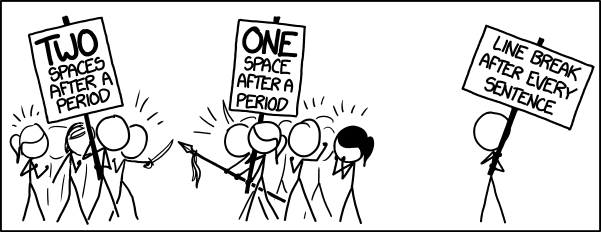
The current state of the battle is neatly captured by xkcd is this amusing cartoon

third_way.png

As it turns out, the third way actually exists. In the Troff typesetting system it’s traditional in preparing the input to end each sentence with a period followed by a newline. In Groff, this allows one to specify how much space to put between sentences. For example, both my books were typeset with 1.5 spaces between sentences. If the production people had complained too loudly (they really do like one space), I could have simply adjusted a single parameter to get the desired spacing. Thus, at least in some circumstances, the third way is the best way.

Footnotes:

1

Even these conventions are not as rigid as some believe. See the Wikipedia sentence spacing article on the history of sentence spacing practice. The French, for example, favored a single space even in typewritten text and up until the late 1990s many printers used 1.5 spaces. Although partisans on both sides are emphatic that their choice renders text more legible, scientific studies don’t support this.

Posted in General | Tagged | 3 Comments