
-
Recent Posts
Links
Archives
- July 2026
- June 2026
- May 2026
- April 2026
- March 2026
- February 2026
- January 2026
- December 2025
- November 2025
- October 2025
- September 2025
- August 2025
- July 2025
- June 2025
- May 2025
- April 2025
- March 2025
- February 2025
- January 2025
- December 2024
- November 2024
- October 2024
- September 2024
- August 2024
- July 2024
- June 2024
- May 2024
- April 2024
- March 2024
- February 2024
- January 2024
- December 2023
- November 2023
- October 2023
- September 2023
- August 2023
- July 2023
- June 2023
- May 2023
- April 2023
- March 2023
- February 2023
- January 2023
- December 2022
- November 2022
- October 2022
- September 2022
- August 2022
- July 2022
- June 2022
- May 2022
- April 2022
- March 2022
- February 2022
- January 2022
- December 2021
- November 2021
- October 2021
- September 2021
- August 2021
- July 2021
- June 2021
- May 2021
- April 2021
- March 2021
- February 2021
- January 2021
- December 2020
- November 2020
- October 2020
- September 2020
- August 2020
- July 2020
- June 2020
- May 2020
- April 2020
- March 2020
- February 2020
- January 2020
- December 2019
- November 2019
- October 2019
- September 2019
- August 2019
- July 2019
- June 2019
- May 2019
- April 2019
- March 2019
- February 2019
- January 2019
- December 2018
- November 2018
- October 2018
- September 2018
- August 2018
- July 2018
- June 2018
- May 2018
- April 2018
- March 2018
- February 2018
- January 2018
- December 2017
- November 2017
- October 2017
- September 2017
- August 2017
- July 2017
- June 2017
- May 2017
- April 2017
- March 2017
- February 2017
- January 2017
- December 2016
- November 2016
- October 2016
- September 2016
- August 2016
- July 2016
- June 2016
- May 2016
- April 2016
- March 2016
- February 2016
- January 2016
- December 2015
- November 2015
- October 2015
- September 2015
- August 2015
- July 2015
- June 2015
- May 2015
- April 2015
- March 2015
- February 2015
- January 2015
- December 2014
- November 2014
- October 2014
- September 2014
- August 2014
- July 2014
- June 2014
- May 2014
- April 2014
- March 2014
- February 2014
- January 2014
- December 2013
- November 2013
- October 2013
- September 2013
- August 2013
- July 2013
- June 2013
- May 2013
- April 2013
- March 2013
- February 2013
- January 2013
- December 2012
- November 2012
- October 2012
- September 2012
- August 2012
- July 2012
- June 2012
- May 2012
- April 2012
- March 2012
- February 2012
- January 2012
- December 2011
- November 2011
- October 2011
- September 2011
- August 2011
- July 2011
- June 2011
- May 2011
- April 2011
Categories
Meta
Real Time Internet Monitoring
If you’re like me, you probably enjoyed the spectacle of Tom Matzzie live-tweeting an overheard off-the-record conversation between Ex NSA Director Michael Hayden and a reporter. The hilarity was terminated when a colleague of Hayden called him to warn of the eavesdropping.
I snickered at the irony but didn’t think much about it. Now Bruce Schneier remarks that what this really demonstrates is that the government is monitoring the Internet in real time. The tweets, of course, are public so it doesn’t rise to the level of abuse of the NSA’a extra-legal activities but it still shows that those public feeds are being monitored and in real time.
Schneier says that he doesn’t think that this means that the NSA is monitoring the Internet; he believes it more likely that some PR organization assisting the NSA with the Snowden revelations was monitoring social media for names connected to the NSA. I’m not so sanguine but it doesn’t really matter if it was the NSA or some other government-connected entity. The government should have better things to worry about. Getting healthcare.gov running would be a good start.
The Third Way
If you’ve been paying attention lately you’ve probably noticed the raging dispute concerning how many spaces are appropriate at the end of a sentence. If you learned to type on an actual typewriter you were taught the hard and fast rule that the correct answer is two. If you’re a typography geek you almost certainly believe—equally strongly—that the correct answer is one.1
The typography geeks claim that using two spaces evolved because of monospaced typewriter script but that it doesn’t make any sense with proportional fonts and that, in fact, typographers have never adhered to the two space rule. Most people appear to accept that explanation even if they insist on two spaces out of a long ingrained habit.
You’d think that would be the end of it but the two-space partisans have pushed back challenging the conventional history and claiming that the one space rule was all about publishers trying to save some paper. According to this telling of the story, the real historical practice was to have slightly larger spaces between sentences and that the one space rule is less than 60 years old.
The current state of the battle is neatly captured by xkcd is this amusing cartoon
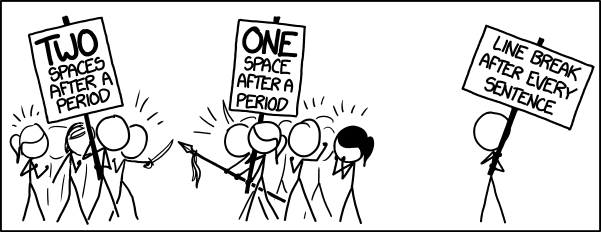
As it turns out, the third way actually exists. In the Troff typesetting system it’s traditional in preparing the input to end each sentence with a period followed by a newline. In Groff, this allows one to specify how much space to put between sentences. For example, both my books were typeset with 1.5 spaces between sentences. If the production people had complained too loudly (they really do like one space), I could have simply adjusted a single parameter to get the desired spacing. Thus, at least in some circumstances, the third way is the best way.
Footnotes:
1
Even these conventions are not as rigid as some believe. See the Wikipedia sentence spacing article on the history of sentence spacing practice. The French, for example, favored a single space even in typewritten text and up until the late 1990s many printers used 1.5 spaces. Although partisans on both sides are emphatic that their choice renders text more legible, scientific studies don’t support this.
Full Screen Magit Status
Ever since he posted it last December, I’ve been a huge fan of Magnar Sveen’s hack to display magit-status in full screen and then restore the previous window configuration upon quitting. It’s nice because you can commit a file and then have everything back the way it was.
Yesterday, it stopped working. After a little sniffing around, I discovered that the problem was that magit-quit-window was renamed to magit-mode-quit-window. If you used the code that Sveen posted it’s probably still working for you but I used some revised code suggested in a comment by Brad Wright. The idea is to call the normal termination routine and then restore the window configuration.
I used slightly different code
(defadvice magit-quit-window (after magit-restore-screen activate)
  (jump-to-register :magit-fullscreen))))
from Wright’s but the fix is the same with either version. Simply change the magit-quit-window to magit-mode-quit-window and everything will work again.
Common Lisp Features
A couple of years ago, Lisp luminary Nikodemus Siivola rescued and reposted Abhishek Reddy’s Features of Common Lisp page. It serves as a nice introduction to what makes Common Lisp such a great development environment. It doesn’t, of course, cover every feature and it doesn’t examine the ones it does cover in depth. Still, it’s a useful resource for someone who wants to see what the excitement is about.Even if you’re an experienced Lisper, you may find it interesting. It’s well worth a look.
While you’re at it, you might also want to have a look at Siivola’s Common Lisp FAQ. I’ve mentioned that a couple of times before and highly recommend it.
Building Password Lists
A little while ago Ars Technica published an interesting article on how password crackers build their lists of trial passwords. The TL;DR is that they scan Wikipedia, Project Gutenberg, news websites, song lyrics, IRC logs, Twitter, and other sources of text that show how people put words together. Then they apply the usual mangling rules to the resulting phrases to generate lists of trial passwords.
Read the article for more details but note that the technique discovered the 51 character password Ph'nglui mglw'nafh Cthulhu R'lyeh wgah'nagl fhtagn1 (it’s from H. P. Lovecraft’s The Call of Cthulhu). The take away from the article is that it is absolutely critical that your passwords be chosen randomly. The best way to do that is to use a password manager that will generate long random passwords for you. That leaves only your master password which must also be random. The problem is that something like b2qJ)spbgT4LxTtE+piK, while secure, is impossible to remember. The solution is to use something like Diceware to choose 5 or 6 random words (like the famous correct horse battery staple from XKCD). I wrote about a Lisp implementation of Diceware if you want to automate the process but all you really need is a die as explained on the Diceware page.
Note that you can’t just choose any 6 words. The choice has to be random. That’s why you roll dice to choose them. The Lisp program I mentioned above gets cryptographically strong random numbers from /dev/random to choose words from the Diceware list. One thing for sure, passwords or passphrases that appear anywhere on the Web will not be secure.
Running Ping in Emacs
Last year I wrote about my delight in discoverying the Emacs Net Utilities. It’s nice to be able to run a quick ping, traceroute, or even some of the other network utilities right from Emacs. I’ve found, however, that there is a psychological barrier to using them. When you do a ping (or whatever) it opens a new window and leaves it and the corresponding buffer hanging around until you clean them up. That’s not much of a barrier, of course, but it is enough that I found myself using the terminal instead. Silly, I know, but there it is.
Of course, this is Emacs so I can have it my way. I decided to run ping and traceroute alone in the frame using the strategy suggested by Magnar Sveen for Magit. I wanted to see the output and then be able to press 【q】 to destroy the buffer and restore the previous window configuration. It’s hard to see, I know, how this is much easier than simply typing 【Ctrl+x k】 to cleanup but it seems like it is to me and you do end up with everything the way it was before you started, which may or may not be true of just killing the window.
It’s a bit trickier than for magit because there’s no quit function: ping just runs and then leaves the buffer in place. Also, there’s no convenient keymap to hook into. My first try was to wait on a keypress using read-key with a prompt of “Press any key to continue” but that was too ugly. For one thing, you couldn’t temporarily switch away from the buffer or doing anything else requiring keyboard input.
I finally settled on establishing a temporary keymap where 【q】 causes a separate function to be called that kills the buffer and restores the old configuration. Once I figured out what I wanted to do, the code was pretty simple:
(defun net-utils-restore-windows ()
  "Restore windows and clean up after ping."
  (interactive)
  (kill-buffer (current-buffer))
  (jump-to-register :net-utils-fullscreen))

(defadvice net-utils-run-program (around net-utils-big-page activate)
  (window-configuration-to-register :net-utils-fullscreen)
  (let ((buf ad-do-it))
    (switch-to-buffer buf)
    (delete-other-windows)
    (set-temporary-overlay-map
      (let ((map (make-sparse-keymap)))
        (define-key map (kbd "q") 'net-utils-restore-windows)
        map))
    (message "Type \"q\" to restore other windows.")))
This only works with ping and traceroute because the other network utility functions call a different display routine. I could do essentially the same thing for them but I virtually never use them so I didn’t bother.
This isn’t a big thing, of course, but it does reduce my workflow friction a bit so it’s a win for me. And, of course, it demonstrates once again how flexible and extensible Emacs is.
What Foiled Terrorist Plots?
Rick Falkvinge has a great article that makes an obvious point. We can know for sure that government surveillance has foiled exactly zero terror plots. We know this because planning, let alone carrying out, terror plots is a crime but there have been no trials or convictions.
In my first ever post about the NSA scandal, I noted that the NSA’s director, Keith Alexander, claimed that the surveillance had foiled “dozens,” later updated to “over 50,” terror plots. Of course no details were offered. But as Falkvinge says, where are the criminal proceedings?
That brings us back to my original question. Where is the press on all this? The government is clearly lying but there’s nary a word from the main stream press. If it wasn’t for The Guardian (and yes, lately, the New York Times) we wouldn’t know what the NSA was doing and why it matters.
Read Falkvinge’s article. It serves as an excellent reminder of how no government can be trusted to tell us the truth. As I.F. Stone famously said, “All governments are run by liars and nothing they say should be believed.” The NSA scandal neatly illustrates this. Everything they’ve said about Snowden’s revelations have been shown to be lies. Believe them at your peril.
The End of Journalism
Many of you know that I’m not a fan of newspapers or most journalists. When reporters aren’t pursuing an agenda or otherwise abdicating their journalistic responsibilities, they run around chasing trivia and sideshows like the seemingly never ending series of Where’s Waldo articles on Edward Snowden.
On the Snowden matter, one notable exception has been Glenn Greenwald who has pretty much owned the NSA snooping story. Now Greenwald has delivered a stinging rebuke to his fellow journalists. What kindled his anger was a column by Chris Blackhurst, an executive and, until recently, the editor of the UK daily, The Independent. In it, Blackhurst says he wouldn’t have published the Snowden material because, “If MI5 warns that this is not in the public interest, who am I to disbelieve them?” Really? “Who am I to disbelieve them?” It should infuriate even the Where’s Waldo division of the fifth estate that this man calls himself a journalist.
It certainly infuriated Greenwald who explains at length why it’s Blackhurst’s damn job to disbelieve them. Follow the link to experience his righteous anger first hand. If you think you’re being under served by the media, you’re sure to find much to agree with.
Posted in General
Leave a comment
CrptoSeal Shuts Down
The U.S. Government’s overreaching has claimed another victim. The CryptoSeal VPN service has pulled the plug. These are good guys who did everything possible to provide a secure, private VPN service. They didn’t keep logs and could provide authorities only with user billing information.
In the aftermath of the Lavabit case they felt that the FBI or other government entity would use a pen register warrant as leverage to demand the site’s SSL encryption key thereby rendering all the site’s users vulnerable. As a result they have shut down their service and destroyed all customer records.
I’m of two minds about this. On the one hand their customers have been inconvenienced but are safe. In this regard, they are heroes; they shut down their business rather than be a party to what they consider crimes against innocent people by an out of control government. On the other hand, they are advancing the government’s cause by eliminating one more means for people who value their privacy to use the Web in a secure and confidential manner. That’s a tragedy that should concern us all.
This case shows, once again, how important it is to insist that the government knock off their thuggish behavior and start respecting citizens’ rights. They will, of course, scream “terrorist” and “think of the children” and all the other nonsense they always spout when they get caught with their hands in the cookie jar but it’s time to demand an end to their extralegal activities.